
Your Major Feels Pointless and AI Might Be Why. Let's Talk About That.
AI anxiety in college students: what it is, why it is so widespread right now, and how to stop it from running your life
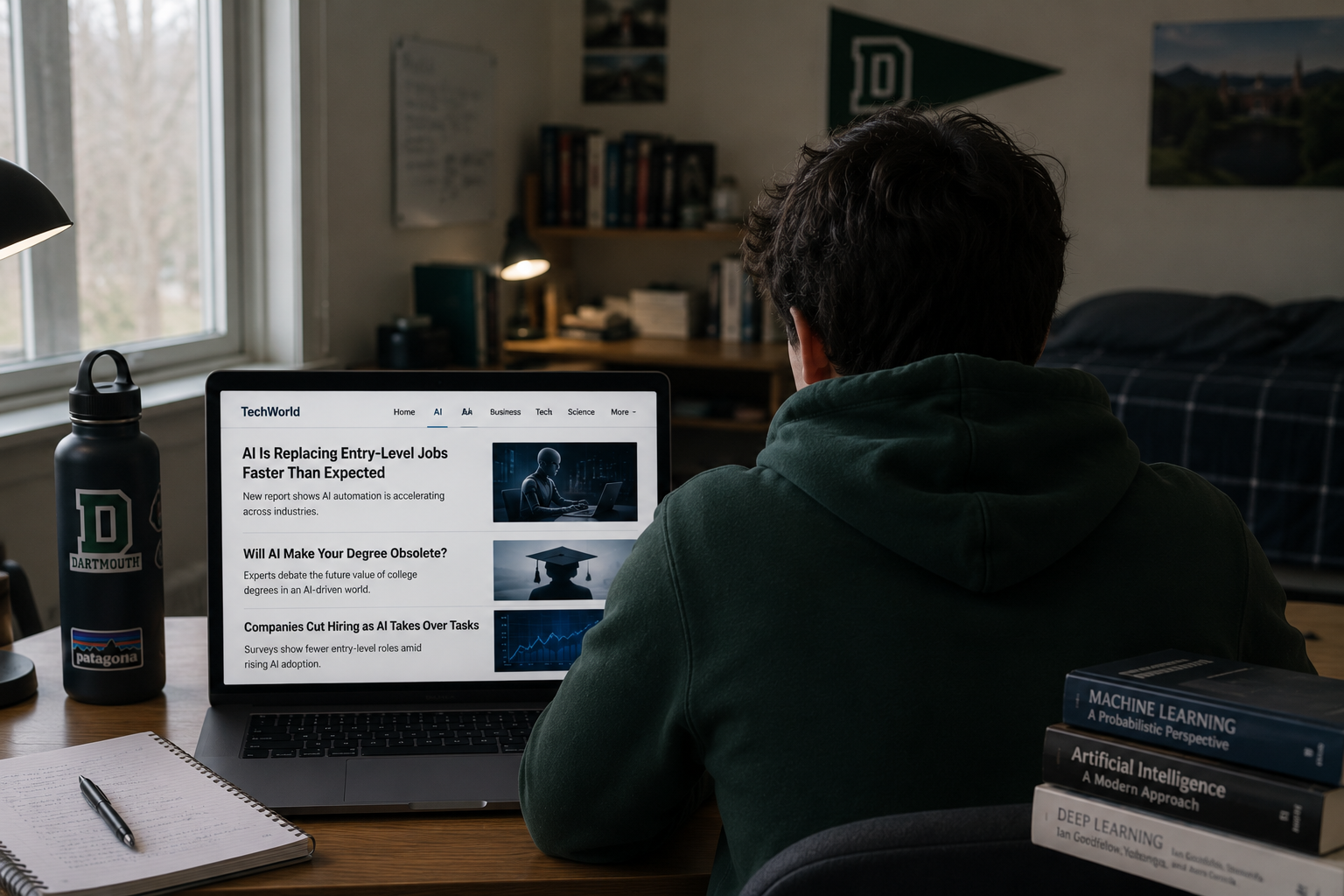
You spent years working toward a plan. You chose a major, maybe switched it, chose again, built a version of your future around it. And then, somewhere in the last couple of years, that plan started feeling a lot less solid. The thing you were training to do can now be partially automated. The entry-level jobs that were supposed to build your career are disappearing before you graduate. And everywhere you look, someone is either telling you AI is going to be fine or that it is going to take everything.
If the uncertainty is making you anxious, you are not being dramatic. AI anxiety in college students is a documented, measurable psychological phenomenon, and it is affecting a significant portion of your generation right now. At Semester Health, career-related anxiety and existential uncertainty about the future are among the most common things students are bringing into sessions right now. Here is what is actually going on and what you can do about it.
How Widespread Is AI Anxiety Among College Students?
Very. A 2025 poll by the Institute of Politics at Harvard Kennedy School found that nearly 70% of college students see AI as a direct threat to their job prospects. A separate Cengage survey found that 51% of 2024 graduates second-guessed their career choices specifically because of how fast AI was advancing. Computer science majors are among the most affected, with 28% of graduating seniors describing themselves as very pessimistic about their career prospects, a 10 percentage point jump from the previous year.
These are not niche concerns. They are widespread across majors, particularly among students in technology, business analytics, writing-adjacent fields, and anything involving data, research, or content. The anxiety is not irrational either. The World Economic Forum projects that 92 million existing jobs will be displaced between 2025 and 2030, while 170 million new ones are created. The net is technically positive. But the disruption in the middle is real, and it is happening right as you are trying to build your career foundation.
What AI Anxiety Actually Feels Like Day to Day
AI anxiety does not always show up as a clear, nameable fear about robots taking jobs. More often it shows up as a vague, persistent background noise that colors everything:
Feeling like the skills you are learning are already becoming obsolete before you finish your degree
A low-grade dread when you read news about AI advancements in your field, even when the tone is positive
Difficulty committing to a career path because everything feels unstable and choosing feels risky
Guilt or shame around using AI tools in your coursework, combined with anxiety about being left behind if you do not
A sense that the goalposts keep moving and no matter how much you prepare, you cannot quite catch up
Existential questions about the value of your education that are hard to shake and harder to talk about
A 2025 study published in Scientific Reports examined AI anxiety in college students and found that it directly and negatively predicted career decision-making, with the anxiety undermining something called career adaptability, which is essentially the ability to stay flexible and responsive in the face of change. In other words, the more anxious students were about AI, the harder they found it to make any career decisions at all. The anxiety did not sharpen their thinking. It paralyzed it.
Why This Generation Has It Harder Than Any Before
Every generation has dealt with economic uncertainty during their college years. But the current situation has a few features that make it genuinely different from what came before
AI is targeting entry-level work specifically
Previous waves of automation tended to displace routine manual work first. AI is doing something different: it is particularly good at the cognitive, writing, research, and analytical tasks that entry-level knowledge workers are hired to do. The career ladder that used to start with internships and junior roles is being compressed from the bottom up. Recent college graduates now account for just 7% of new hires, down from 11% in 2022. The traditional pathway from college to career that earlier generations could rely on is genuinely less reliable right now.
The pace of change outstrips the pace of education
Universities take years to update curricula. AI capabilities are changing in months. The gap between what you are learning and what the job market actually needs right now is wider and more volatile than it has ever been. That is not your fault, and it is not a reflection of the value of your education. But it is a real source of anxiety that deserves to be named.
The information environment is relentlessly negative
Every week brings a new headline about which jobs AI will eliminate next. Your social media feed surfaces the most alarming takes because alarm drives engagement. You are not getting a balanced picture of what is happening. You are getting the most emotionally activating version of it, on repeat, designed to keep you scrolling.
Your anxiety about AI is not a sign that you are catastrophizing. It is a sign that you are paying attention. The question is not whether to take it seriously. It is how to take it seriously without letting it run your life.
If AI-related anxiety has been affecting your ability to make decisions or just your daily mood, talking to a therapist can help you think more clearly and feel less stuck. Book a session with Semester Health.
The Mental Health Layer Nobody Is Talking About
Career anxiety about AI is not just a practical problem. It has real mental health consequences that are worth taking seriously.
Research on AI anxiety consistently links it to symptoms of generalized anxiety, including difficulty concentrating, disrupted sleep, avoidance of career-related tasks, and a persistent sense of dread that is hard to shake even when things are objectively going fine. For students who are already managing anxiety or depression, AI-related uncertainty adds a layer of existential weight that can tip a manageable situation into something harder.
There is also a specific psychological pattern that shows up with this kind of uncertainty: the more uncertain the future feels, the more the brain tries to resolve the uncertainty by thinking about it constantly. But because the uncertainty is genuinely unresolvable right now, the thinking does not produce relief. It just produces more anxiety. This is the same loop that drives health anxiety, relationship anxiety, and any other kind of worry that circles a problem that cannot be solved through thinking alone.

What Actually Helps
The goal is not to stop caring about your future or to pretend the disruption is not real. The goal is to develop a relationship with uncertainty that does not leave you paralyzed. Here is what research and clinical practice point to:
Separate what is real from what is projected
AI anxiety feeds on speculation. A lot of what is circulating about which jobs will disappear and when is projection, not certainty. Your specific field, your specific skills, your specific trajectory have a much more nuanced picture than any headline can capture. Deliberately seeking out accurate, measured analysis of your industry rather than consuming the most alarming takes is not denial. It is information hygiene.
Focus on adaptability rather than certainty
The research on who navigates AI disruption well points consistently to career adaptability: the ability to learn new skills, reframe setbacks, and stay flexible in the face of change. Adaptability is a psychological skill, not just a professional one. It is also something therapy directly helps build.
Limit your exposure to AI doom content
This is not the same as burying your head in the sand. It is recognizing that consuming three hours of AI-related anxiety content per day does not make you better prepared. It just keeps your nervous system in a state of threat activation. Set intentional limits on how much time you spend engaging with this kind of content, particularly in the evening.
Reconnect with what you are actually good at
AI anxiety often triggers a broader devaluation of your existing skills and abilities. One of the most useful counterweights is deliberately reconnecting with what you are genuinely good at, what people consistently come to you for, and what you find meaningful. Your value is not reducible to the tasks AI can automate. Most of it is not.
Talk to someone
Career anxiety that has crossed into persistent worry, avoidance, or hopelessness is not something you should be managing alone. Cognitive Behavioral Therapy is particularly effective for this kind of uncertainty-driven anxiety, and a therapist who understands what college students are navigating right now can help you develop a more functional relationship with a genuinely uncertain future.
If AI anxiety has been affecting your mental health, your ability to make decisions about your future, or just your general quality of life, Semester Health works specifically with college students navigating exactly this. Virtual sessions, flexible scheduling, and therapists who understand what your generation is actually dealing with.
Frequently Asked Questions
Is AI anxiety a recognized psychological condition?
AI anxiety is not a formal diagnosis, but it is a well-documented psychological phenomenon studied in peer-reviewed research. It describes the apprehension and distress that comes from perceiving AI as a threat to one's competence, identity, or career stability. When it significantly affects daily functioning, it warrants the same attention as any other form of anxiety.
Should I change my major because of AI?
That is a decision worth making from a grounded, informed place rather than from a place of panic. The fields most affected by AI are shifting rapidly, but so is what AI needs humans to do alongside it. Talking to people working in your field and a career counselor is more useful than reacting to headlines. A therapist can also help you make this kind of decision from a clearer headspace.
Is it reasonable to feel hopeless about the job market right now?
The job market for new graduates is genuinely more difficult than it was a few years ago, and that difficulty is real, not imagined. Hopelessness, though, is a cognitive state that tends to close off options rather than help you navigate them. If hopelessness has become persistent, that is worth addressing directly with professional support.
Will AI really take my job?
The honest answer is: it depends on the job, the field, and the timeline. AI is automating specific tasks within jobs more than eliminating entire jobs outright, at least for now. The disruption is real but more nuanced than the most alarming headlines suggest. What is clear is that adaptability, continuous learning, and uniquely human skills are increasingly valuable.
How do I stop doomscrolling about AI?
Set hard time limits on the specific apps or sites where you consume AI-related content, move those apps off your home screen, and create phone-free windows during the parts of your day when the anxiety is highest. Structural limits work better than willpower. If the compulsive checking is driven by anxiety, addressing the underlying anxiety with a therapist tends to reduce it more sustainably.
Can therapy help with career anxiety?
Yes. CBT is well-suited for the kind of uncertainty-driven anxiety that underlies AI-related career fears. A therapist helps you identify the specific thought patterns driving the anxiety, build a more functional relationship with uncertainty, and make clearer decisions without the paralysis that unmanaged anxiety produces.
What if my anxiety about AI is actually valid?
It probably is, at least in part. Acknowledging that the concern is grounded in something real is part of working with it effectively. The goal of therapy is not to talk you out of a valid concern. It is to help you engage with it in a way that is functional rather than debilitating.
